I do not believe that people can escape their origins. In any case, I have not been able to escape mine. It would be a mistake to extrapolate from my experience a universal one. It could be a lack of imagination that keeps me from the basic transgression which obliterates limits and pushes a mind past the place of its birth. That said, if it is true that human minds operate from analogy—”this is like that, that is not like this”—then origins supply much of the grounding upon which the epistemic jenga of stacked analogies steadies itself.
I turn off a road named “Freedom” and into a trailer park with old roads whose sound—a loose rattle of gravel—tugs at memory. The homes have had decades to settle into their plotted sequence of lots. They tilt with age and wear their fading collage of mismatched paint choices with worn out confidence. I drive slowly over a speed bump, followed by another, and reach for the knob that controls volume, letting rhythm dissolve into faint crackles.
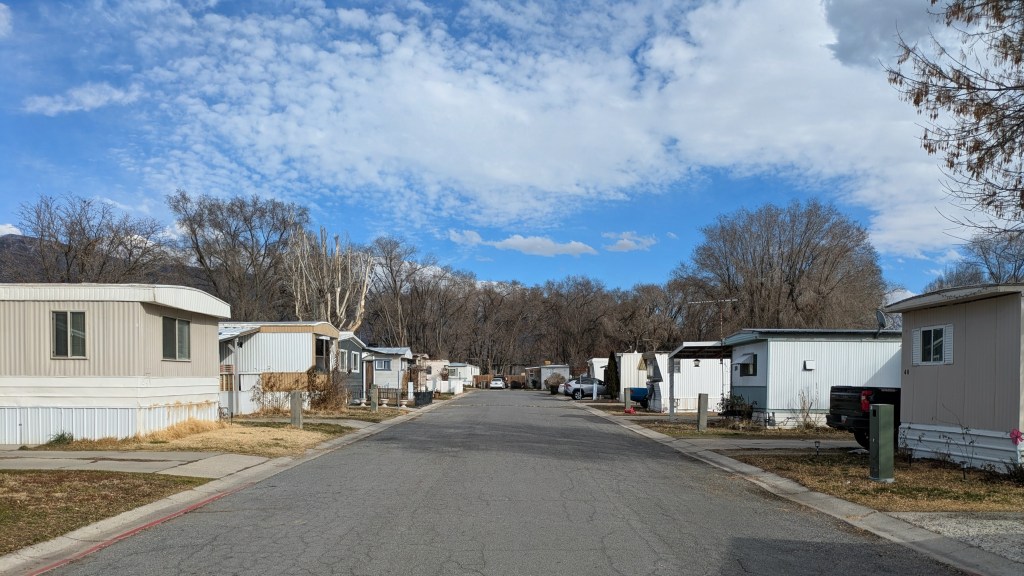
My parents lived here when I was born. I clung to my first gasping breaths in a hospital only a few miles away. Yet, the mnemonic sway this place holds over me feels familiarly fragmented. I cannot remember which plot my parents rented for their mobile home, or which playgrounds I toddled around to hone developing motor skills. My memory of the Park off Freedom Boulevard—with its cluttered collection of lives traveling between narrow roads and wild hedges—is a fleeting impression that belongs more to the body than to conscious awareness.
I crack a window and pass a dozen kids playing some game or another in an open field. They chatter away in a polyglot cauldron of English and Spanish that renders ridiculous any politics that attempts to insulate a culture from the influence of others. “Play,” I say out loud to myself, “is the only true lingua franca,” and, in response, kids shout and laugh across language barriers, a través de las barreras del idioma.
Left to wander, the imagination can zoom up and out to situate this place topographically in a metropolitan area squeezed between mountains to the east and a lake to the west. Growing up, my friends and I used to jokingly refer to it as “The U.C.,” with the acronym’s corresponding words being “Utah” and “County.” Having grown up, I typically call it “Utah Valley,” because it was a valley before it was organized as a county, and I prefer a chronology that acknowledges the enormity of deep time.
I pull out of the trailer park past Freedom and make my way toward the old State Road that knitted the valley together before there were highways. Heading east, I can see snow-capped mountains that reach godlike into a clouded sky. All perception finds expression in the space between sense—contact with the physical—and sensuality—the body’s response to physical stimuli. “This truth might shackle bodies to places,” I say out loud to myself, “but the limits chains impose beg for transgression.”
 trending velocities