My dissertation existed for a long time as a vague idea rattling around in my skull. I knew that at some point I would have to complete my research, interpret my sources, and piece together a narrative for my committee to read and consider. But that point sat barely visible over some distant horizon. When I stepped off the bus in Topeka, Kansas on July 16, 2021, and took a deep breath of the humid heat, I knew that the distance between that point and me had started to close. I had been on the road for over a month, traveling between archives in Washington, D.C., Boston, Chicago, and Topeka, and I had finally collected enough sources to conclude my research. My flight back to Utah left in the morning.
I looked up at the Menninger Clocktower in the hills above me and began to climb. My research on the history of psychiatry had brought me to Topeka because, once upon a time, the Menninger family had run a clinic there on the outskirts of town. The brothers Karl and William Menninger had honed their skills at the clinic and published widely on the topic of mental health through much of the twentieth century. Doctor Will, as William Menninger was known to his friends and colleagues, had run a research project on “industrial mental health” for the Menninger Foundation. Since my dissertation explores how psychologists, psychiatrists, and psychiatric social workers articulated the relationship between work and mental health, I thought it might be a good idea to check out the Menninger Foundation archives stored at the Kansas History Museum a couple miles away from what’s left of the clinic in the hills.
The Menninger Foundation left the clinic behind and moved their operation to Texas about twenty years ago. It has sat abandoned ever since. I followed an old road into the hills and passed a “no trespassing” sign on my way. A security guard from a nearby business noticed and approached me with some irritation. After I explained who I was and what I was doing, he gave me directions through the winding roads and to the clinic. Fortunately, Topekans have a long memory, and most of them have been inculcated with fond memories of the Menninger family. The security guard didn’t think twice about helping me out.
I walked a narrow road lined by trees and watched as the Menninger Clocktower emerged through wild growth.
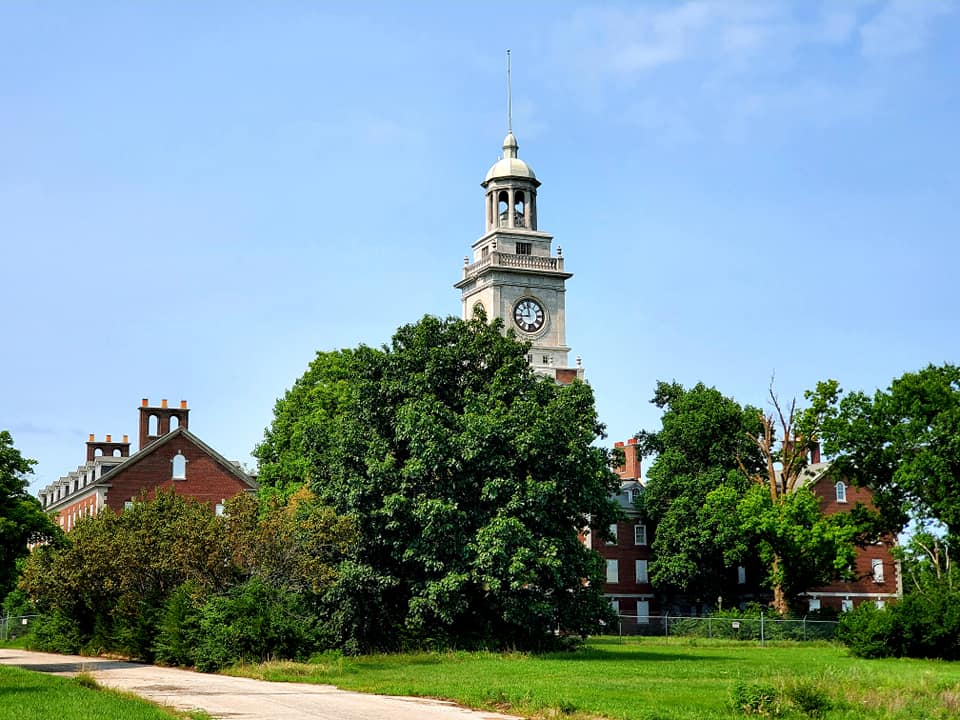
Well before I had decided to work in the Menninger Foundation archives, I had grown fond of the Brothers Menninger, their emphasis on social psychiatry, and their willingness to consider environmental influences on human wellness. Here at the clinic they had pioneered a milieu therapy that asserted patients’ humanity and treated them like family. I admired the Menningers and their contribution to psychiatry, which, I felt, had allowed drug therapy to march the discipline too far down a road of individual treatment for individual bodies at the turn of the twenty first century. I had come, I realized, to pay my respects to the Menningers and their project.
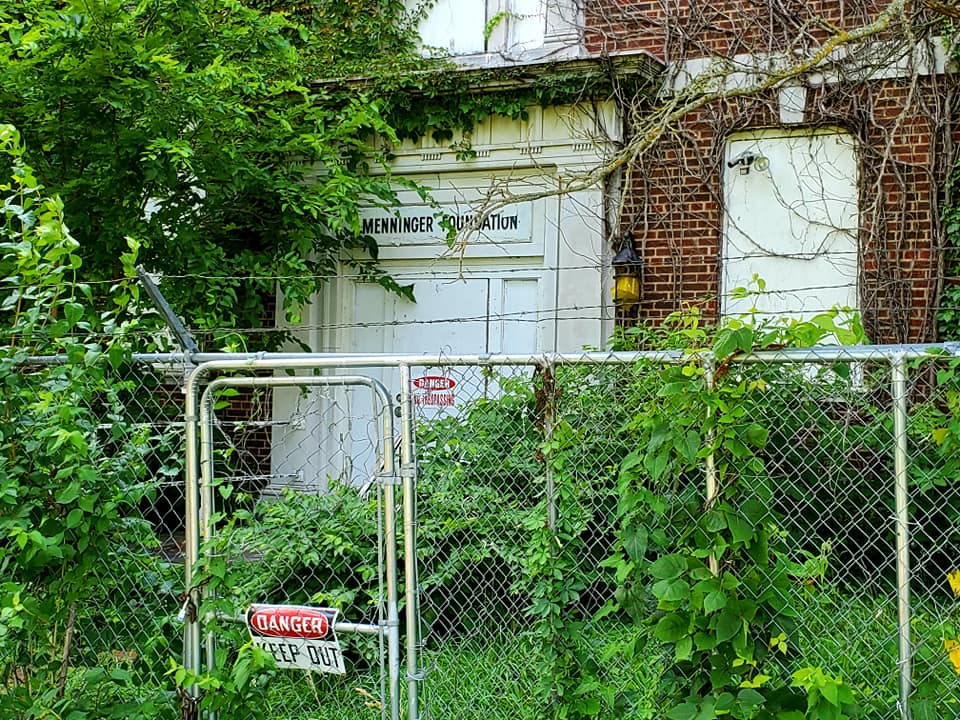
I spoke out loud to the ghosts in attendance. I told them that I would do my best to do them justice. “I don’t know what that means, exactly,” I admitted, “but I’ll figure it out.”
Out there in the ruins of the Menninger clinic I felt my dissertation taking shape.
 trending velocities
Leave a comment